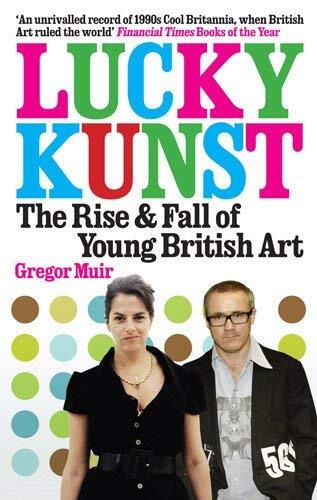

Lucky Kunst: The Rise and Fall of Young British Art

These days artists like Damien Hirst and Tracy Emin are major celebrities. But Gregor Muir knew them, and many of the other artists who came to fame in London during the eighties and nineties in an extraordinary explosion of new talent, at the start of their careers, before people even talked about a movement called YBA. His unique memoir is the first history of the birth of Young British Art, and a supercharged snapshot of London subculture.
Muir - who now runs the ICA - describes himself accurately as YBA's 'embedded journalist'. He was the only writer who happened to be in London's Shoreditch and Hoxton before Jay Joppling arrived with his White Cube Gallery, when these little-visited districts were still a semi-derelict landscape of grotty, menacing pubs, cheap loft spaces and squats. In such unprepossessing but certainly atmospheric surroundings he witnessed the coming-together of the remarkable array of young artists - Hirst, the Chapman brothers, Sarah Lucas, Rachel Whitehead, Sam Taylor-Wood, Angus Fairhurst ? who went on to produce a fresh, irreverent, and enormously popular form of art.
Often it was notorious - Hirst's shark, Whiteread's House, Lucas' two fried eggs and a kebab; frequently it was funny and surreal; it always was newsworthy. But just as much fun as their art were their adventures: an almost comic whirl of drunkenness, scrapes and riotous hedonism. But by the time the seminal Sensation show opened at the Royal Academy ? where Muir?s story concludes ? and era had come to an end: YBA was now an established movement of huge importance, which had changed the world forever.
Picturesque, barbed, gritty and hilarious an outlandish saga played out amidst a London landscape now gone forever, Lucky Kunst tells a story never told before, because Greg Muir really was there, and one of the best qualified to tell it.